Rosa Carter · 12 September 2026
Adaptive Eviction Policies That Maintain Responsiveness in Distributed Storage Networks During Surge Periods
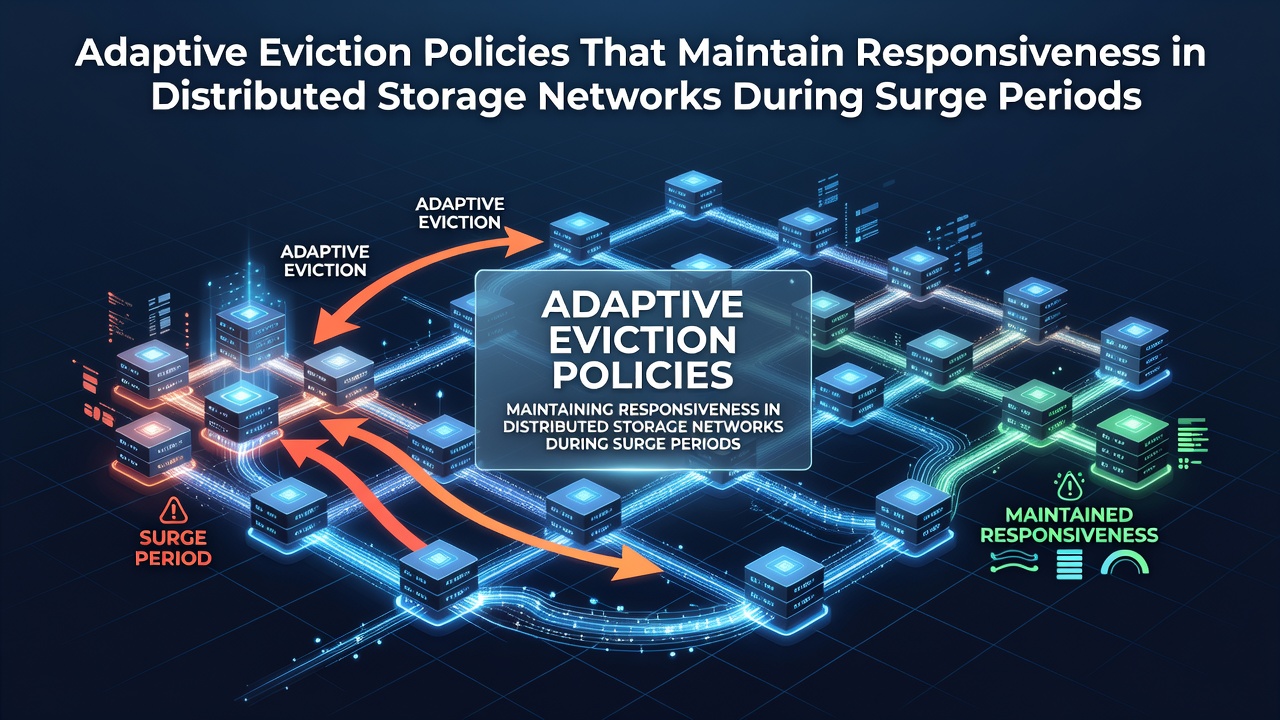
Distributed storage networks face increasing demands when user activity spikes, and adaptive eviction policies provide mechanisms that adjust cache contents based on real-time metrics rather than fixed rules. Researchers have examined systems that combine access frequency, data size, and predicted retrieval costs, and these approaches allow nodes to retain items that support continued operation while removing others during peak loads.
Traditional policies such as least recently used or least frequently used operate with static priorities, yet they often fail to account for sudden changes in request patterns. Studies from institutions including those affiliated with the European Research Council show that networks incorporating machine learning models for eviction decisions experience fewer latency increases when traffic doubles or triples within short intervals. Data collected through 2025 indicates that such models evaluate multiple signals simultaneously and update priorities every few seconds.
Core Components of Adaptive Policies
Adaptive systems rely on several measurable inputs that feed into decision algorithms. Access recency and frequency form the baseline, while network latency estimates and node load levels add context that static methods overlook. When a surge begins, the policy recalculates eviction scores and selects candidates whose removal frees space without disrupting active request streams.
Observers note that combining these inputs requires careful weighting, because overemphasizing one factor can lead to suboptimal retention of large but infrequently accessed objects. Implementations documented in technical reports from the National Institute of Standards and Technology demonstrate that periodic recalibration of weights, often performed hourly, maintains balance across heterogeneous node capacities.
Handling Surge Periods in Practice
Surge periods typically arise from scheduled events or unexpected viral content distribution, and they place simultaneous pressure on bandwidth and storage resources. In September 2026, monitoring platforms recorded multiple incidents where request rates exceeded baseline by factors of five or more within minutes, prompting networks to activate enhanced eviction modes. These modes prioritize objects that multiple clients request concurrently and evict those tied to single-user sessions or low-priority background tasks.
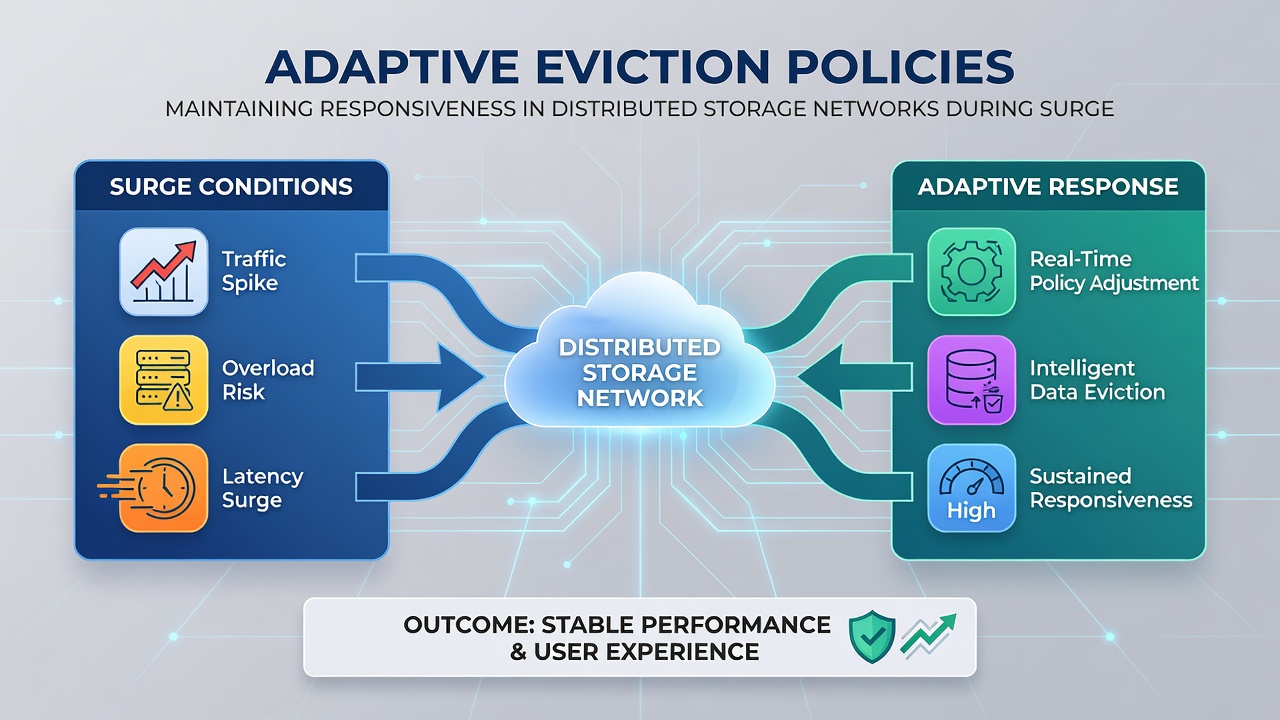
Engineers have tested threshold-based triggers that activate when queue lengths surpass predefined limits, and the resulting policies shift from conservative retention to aggressive replacement. One documented deployment in a North American content delivery infrastructure showed that adaptive scoring reduced average response time by 18 percent compared with fixed least-recently-used during a documented three-hour peak. The same study found that memory utilization remained within operational bounds because eviction decisions incorporated projected future access probabilities derived from recent trend analysis.
Integration with Broader Network Management
Eviction policies do not operate in isolation; they interact with replication strategies and load-balancing algorithms that distribute requests across available nodes. When one region experiences elevated demand, data items may migrate toward edge locations while the eviction layer removes duplicates or stale versions. Reports from the Australian Research Council highlight that coordinated migration and eviction together preserve responsiveness even when inter-region links become congested.
Security considerations also influence policy design, because eviction decisions must avoid exposing metadata patterns that could reveal user behavior. Systems that anonymize access statistics before feeding them into scoring functions comply with emerging data-protection frameworks in multiple jurisdictions. Ongoing work at several universities continues to refine privacy-preserving aggregation techniques that still supply accurate inputs for adaptive algorithms.
Performance Measurement and Refinement
Networks track hit rates, tail latencies, and eviction frequency as primary indicators of policy effectiveness. Continuous logging allows operators to compare outcomes across different weighting schemes and to adjust parameters after each major event. Figures released by research consortia indicate that systems employing reinforcement learning for weight tuning achieve stable performance across successive surges, whereas manually tuned policies require periodic human intervention.
Hardware variations among nodes add another layer of complexity, since older storage devices may exhibit different access latencies than newer solid-state units. Adaptive policies that incorporate device-specific cost estimates therefore produce more consistent results across heterogeneous clusters. Field data from deployments spanning multiple continents confirm that such device-aware scoring reduces the occurrence of localized bottlenecks during global traffic events.
Conclusion
Adaptive eviction policies represent a practical response to the variability inherent in distributed storage workloads. By integrating multiple real-time signals and adjusting priorities dynamically, these mechanisms help networks sustain service levels when request volumes increase sharply. Continued refinement through empirical testing and cross-regional data sharing supports further improvements in responsiveness without requiring proportional increases in hardware resources.