Rosa Carter · 25 September 2026
Strategies for Minimizing Data Retrieval Times in High-Traffic Web Services Using Layered Caching Approaches
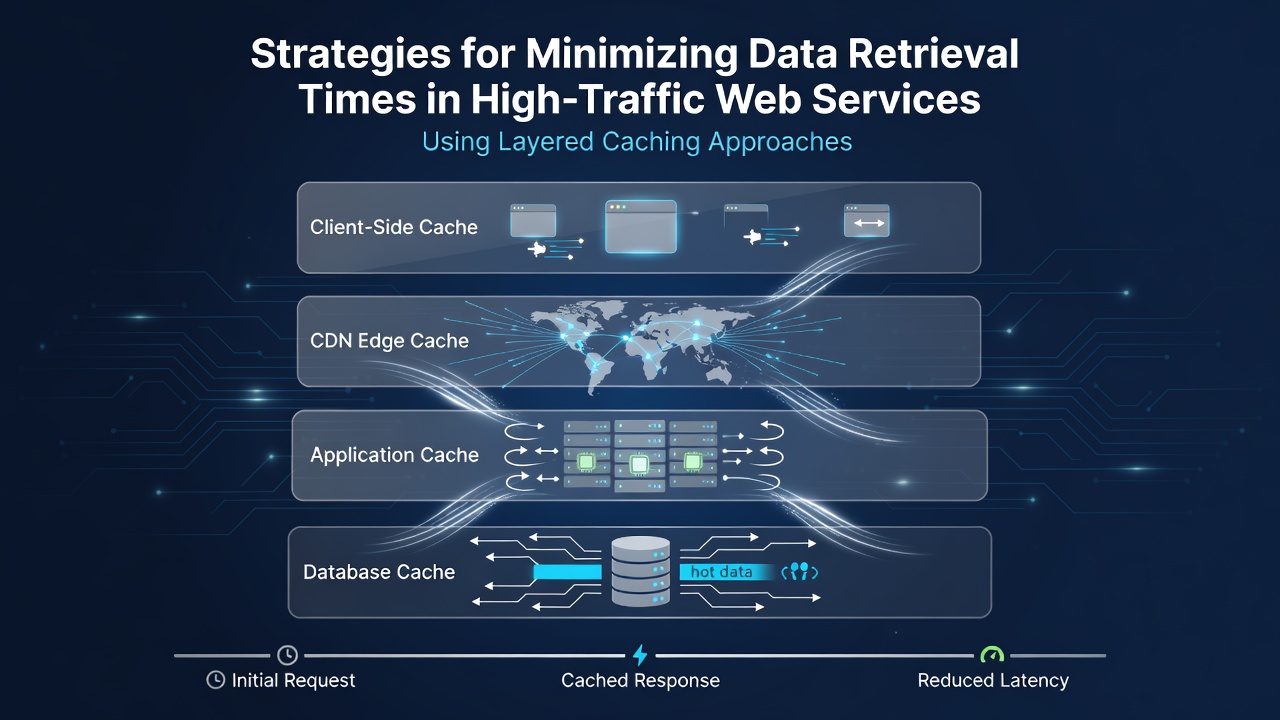
High-traffic web services face constant pressure to deliver data quickly while managing millions of concurrent requests, and layered caching has emerged as a key method for addressing retrieval delays through multiple storage tiers that sit between users and origin servers. Research indicates that combining edge networks, application memory stores, and database query caches reduces latency by serving repeated requests from locations closer to the client or within the service infrastructure itself.
Core Principles of Layered Caching Systems
Layered approaches distribute data across distinct levels where each tier handles specific access patterns and data types, according to studies from institutions like the University of Toronto. Edge caches located in content delivery networks store static assets and frequently requested dynamic content near end users, while regional caches manage aggregated data for geographic clusters, and origin-level caches handle database results or computed objects. This structure allows services to invalidate or refresh entries at the appropriate layer without propagating every change through the entire stack.
Those who've implemented these systems note that cache hit ratios improve when policies align expiration times with data volatility, such as shorter timeouts for user session data and longer ones for product catalogs. Data shows that high-traffic platforms often achieve retrieval times under 50 milliseconds for cached responses during peak loads, whereas uncached queries can exceed several hundred milliseconds depending on database load and network conditions.
Edge and Regional Tier Implementations
Content delivery networks form the outermost layer in many deployments, with providers distributing nodes across continents to intercept requests before they reach central infrastructure. As of September 2026, traffic analyses from North American carriers reveal that edge caches handle over 70 percent of requests for media and API responses in consumer-facing services, which leaves inner layers available for personalized or less common data. Regional caches positioned within data centers then aggregate results from multiple edge locations, applying compression and deduplication techniques that further cut transfer sizes.
Configuration at these tiers involves defining cache keys based on URL paths, headers, and query parameters, while excluding sensitive fields that vary per user. Observers note that services using consistent hashing across regional nodes maintain better balance during traffic surges, preventing individual caches from becoming bottlenecks. And because invalidation signals propagate from inner layers outward, updates to underlying records reach users faster without requiring full cache flushes.

Application and Database Cache Integration
Inside the service boundary, in-memory stores such as Redis or Memcached hold session data, computed aggregates, and API responses that change more often than static assets. Application servers query these stores first before falling back to database connections, and research from Australian academic centers demonstrates that this middle layer can reduce database queries by 60 to 80 percent in read-heavy workloads. Database query caches, whether built into engines like PostgreSQL or implemented via external proxies, store result sets for common SELECT statements while respecting transaction isolation rules.
Coordinating invalidation across layers requires careful event handling, where database write operations trigger messages that propagate to application caches and then to edge nodes. Services that use message queues for these signals maintain consistency without blocking user requests, and figures from European infrastructure reports show average retrieval improvements of 40 percent when such coordination is in place. But here's the thing: mismatched expiration policies between tiers can cause stale data to persist, so monitoring tools track hit rates and eviction patterns at each level to adjust configurations over time.
Performance Measurement and Scaling Considerations
Operators track metrics including time-to-first-byte, cache hit ratios, and backend load to evaluate layered setups, with dashboards surfacing anomalies during traffic spikes. Industry reports from Canadian research networks highlight that services scaling to thousands of requests per second benefit from sharded caches that distribute keys across multiple instances, reducing contention on any single node. Load testing conducted before major events allows teams to simulate September 2026-level traffic volumes and verify that cache layers absorb the majority of requests.
Capacity planning involves estimating working set sizes for each tier, since memory costs rise quickly when caches grow beyond necessary limits. Those managing these environments often combine LRU eviction with size-based limits to keep frequently accessed items resident while discarding larger or older entries. And external links provide additional context on best practices, such as guidelines from the National Institute of Standards and Technology on distributed system performance and findings from ACM digital library papers examining cache coherence in high-volume environments.
Conclusion
Layered caching continues to deliver measurable reductions in data retrieval times for high-traffic web services by placing appropriate data at the closest possible storage tier. Organizations that align cache policies with access patterns, coordinate invalidation across levels, and monitor performance metrics maintain responsiveness even as request volumes increase. The approach relies on established technologies and measurement practices that adapt to evolving traffic conditions without requiring complete infrastructure overhauls.