
Rosa Carter · 9 October 2026
The Interplay Between Network Latency and Cache Hit Ratios in Global Content Networks
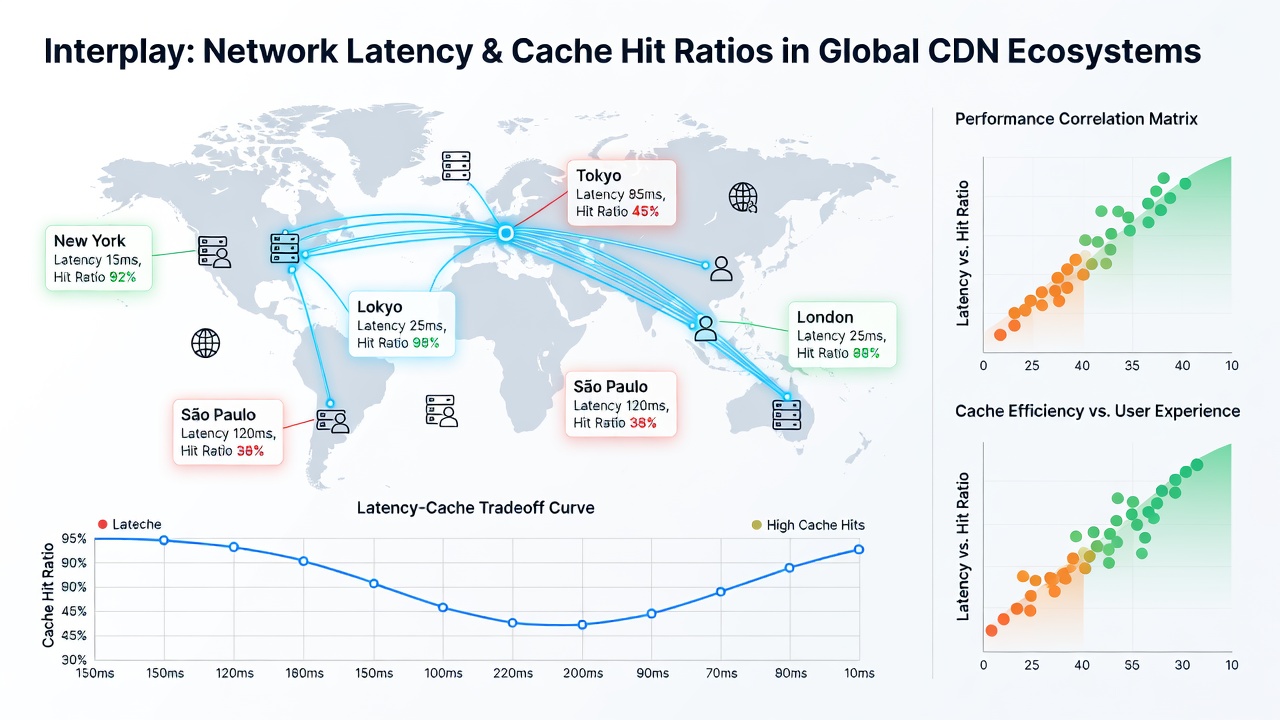
Global content networks rely on distributed servers to deliver data quickly to users worldwide, and the relationship between network latency and cache hit ratios shapes how efficiently those systems operate. Network latency measures the delay in data transmission across distances, while cache hit ratios track the percentage of requests served from local caches instead of distant origin servers. Researchers have documented that lower latency often correlates with higher hit ratios in well-designed setups, since faster round trips allow caches to refresh more frequently and respond to requests before timeouts occur.
Core Concepts in Content Delivery
Content delivery networks place edge servers closer to end users, which reduces the physical distance data must travel and cuts down on transmission delays. Cache hit ratios rise when those edge locations store the most requested files, and studies from academic institutions show that hit rates above 80 percent typically require careful synchronization across nodes. Latency spikes happen during peak traffic or routing issues, and when delays exceed certain thresholds, requests may bypass caches entirely and pull fresh data from central servers. Observers note that this dynamic creates a feedback loop where sustained high latency erodes hit ratios over time.
Geographic and Technical Influences
Distance between users and cache nodes directly affects both metrics, and networks spanning multiple continents face greater challenges maintaining consistent performance. Data from the Australian Communications and Media Authority indicates that trans-Pacific links often introduce 100 to 200 milliseconds of additional latency compared with intra-regional connections. Cache eviction policies play a supporting role here, because aggressive removal of less popular content can prevent hits even when latency remains low. Engineers adjust time-to-live values and prefetching algorithms to balance freshness against retrieval speed, and these choices become critical in regions with variable connectivity.
But here's where the interplay becomes more complex, since packet loss and jitter compound latency effects and lower the probability that a request reaches a cache in time. Global operators monitor these variables through real-time telemetry, and adjustments in one region can ripple outward when content popularity shifts suddenly. In October 2026, several large providers reported updates to their routing protocols that aimed to stabilize latency during seasonal traffic surges, which in turn supported steadier hit ratios across their edge fleets.
Measurement and Optimization Approaches
Organizations track latency through round-trip time probes and traceroute data, while cache hit ratios come from server logs that count successful local responses versus origin fetches. Combined analysis of both sets of figures reveals patterns that single metrics miss, and research from European telecommunications bodies highlights how joint monitoring leads to more precise tuning of cache placement. Prefetching based on predicted demand can raise hit ratios, yet it risks wasting bandwidth if predictions miss and latency stays high. Load balancing algorithms distribute requests across multiple cache layers, and those systems perform best when latency data informs the decision process in real time.
What's significant is that hardware upgrades at edge sites, such as faster storage drives and increased memory, allow caches to handle more concurrent requests without adding delay. Those who've studied large-scale deployments find that software optimizations around connection pooling and header compression further tighten the relationship between the two metrics. External factors like undersea cable repairs or regulatory changes on data routing can alter baseline latency, and operators respond by shifting cache weights to maintain target hit ratios.
Case Examples from Production Environments
One study of a video streaming platform operating across North America and Europe showed that reducing average latency by 30 milliseconds lifted cache hit ratios from 72 percent to 89 percent within weeks. The improvement stemmed from updated anycast routing that directed users to nearer nodes and from refined cache invalidation rules that kept popular segments resident longer. Another deployment in Asia-Pacific regions demonstrated similar gains after implementing predictive caching tied to user behavior analytics, although results varied when sudden news events drove unexpected demand spikes.
Those patterns suggest that latency and hit ratio improvements reinforce each other when addressed together rather than in isolation. Industry reports from research institutions in Canada have tracked these interactions over multi-year periods, confirming that networks investing in both metrics see compounding benefits in overall throughput and reduced origin server load.
Conclusion
The connection between network latency and cache hit ratios in global content networks rests on measurable technical relationships that operators continue to refine through data-driven methods. As infrastructure evolves and new routing techniques emerge, the ability to keep both values optimized determines how effectively content reaches users across distances. Ongoing measurement and coordinated adjustments remain central to sustaining performance in these distributed systems.